Develop a program toolkit
Generate complete program design frameworks for new initiatives with logic models, evaluation plans, and resource guides that transform concepts into implementation-ready programs.
Claude's ability to synthesize program logic and create structured frameworks, combined with your expertise, lets you rapidly develop comprehensive program documentation that typically requires significant coordination and synthesis.
I'm designing a tech workforce preparation program for young adults ages 18-26 from underserved Detroit communities. We'll serve 120 participants annually, helping them prepare for entry-level IT careers.
Program Structure:
Target Outcomes: 80% course completion, 60% job placement within 90 days, $40K average starting salary.
Create a comprehensive program design toolkit in Excel with: program description with mission and goals, logic model (inputs → activities → outputs → outcomes), SWOT analysis with recommendations, evaluation framework with indicators and data collection methods, resource planning (staffing, budget), and executive dashboard.
Make this consulting-grade with premium formatting, sophisticated design, and advanced Excel features. Use a professional color scheme—avoid default Excel colors.
Extended Thinking helps Claude develop more sophisticated program frameworks by planning structure, considering implementation challenges, and testing logic connections before building the toolkit.
Enable Extended Thinking in the conversation settings before starting. This gives Claude space to think through your program's theory of change, identify potential evaluation challenges, and design a comprehensive framework that anticipates real world implementation needs. The extra reasoning time produces significantly more thoughtful program logic and strategic recommendations.
Provide Claude with information on your Theory of Change Model or share documentation that talks about your inputs, outputs, immediate outcomes, and goals. Consider sharing something in the form of: "If we do X → then Y happens → leading to Z impact".

To get the most out of your tailored toolkit, consider providing Claude with the following:
Claude generates a multi-sheet Excel workbook that serves as your complete program planning resource. Each sheet functions as a standalone tool while connecting to create an integrated framework.
I've created a comprehensive program planning Excel workbook. Here's what's included across six interconnected sheets:
Sheet 1: Executive Dashboard A visual summary of your tech training program with key metrics, timeline, and participant outcomes. Clean, professional layout shows annual capacity (120 participants), program phases, and target outcomes including 81% completion rate, 90% certification attainment, and 75% job placement.
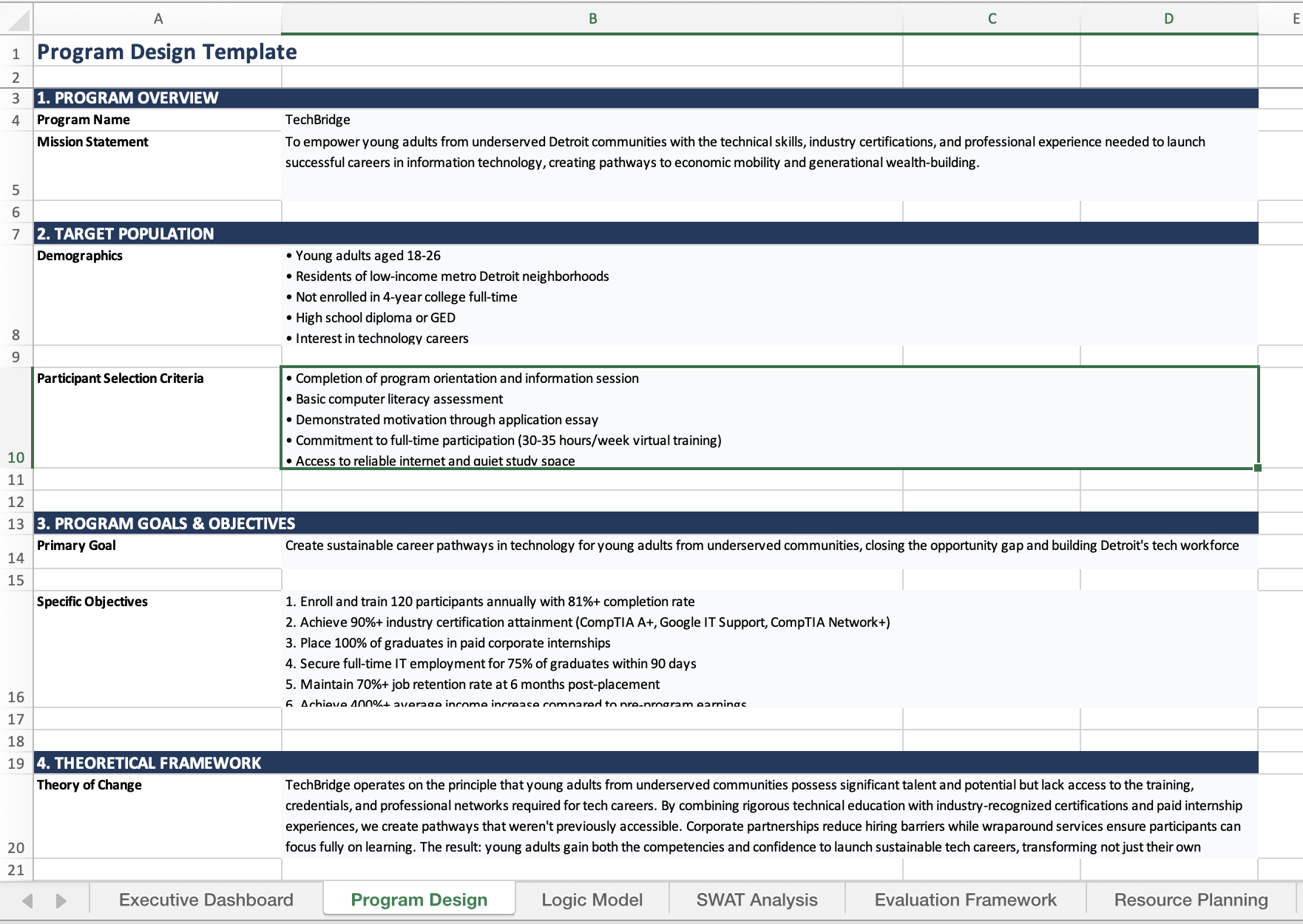
Sheet 2: Program Design Template Complete program narrative covering mission (empowering Detroit youth through tech careers), target population (ages 18-26 from underserved communities), theoretical framework (closing opportunity gap through training + certifications + internships), and detailed breakdown of all three phases plus wraparound services. Structured for easy adaptation into grant proposals.
Sheet 3: Logic Model Visual framework mapping your inputs (budget, staff, partnerships) → activities (technical training, professional development, internships, support services) → outputs (120 enrolled, 97 completers, 87 certified, 73 placed in jobs) → short-term outcomes (industry certifications, IT employment, living wages, professional networks) → long-term impact (economic mobility, poverty reduction, Detroit talent retention). Color-coded by category with clear causal pathways.
Sheet 4: SWOT Analysis Matrix Strategic planning tool. Each quadrant includes specific strategic recommendations for leveraging strengths, addressing weaknesses, pursuing aspirations, and mitigating threats.
Sheet 5: Evaluation Framework Comprehensive measurement plan with 12 outcome indicators including: process measures, outcome measures, impact measures, and satisfaction measures. Each indicator shows target, data source, collection method, frequency, responsible party, and current status. Includes data validation dropdowns for tracking progress (On Track/Needs Attention/In Progress) with color-coded status visualization.
Sheet 6: Resource Planning Detailed breakdown including staffing and operating budget.
Use this to create an implementation timeline that can be leveraged to get the program off the ground.
Add a new sheet with a detailed implementation timeline. Break down the first year into phases: planning/partnership development, staff hiring and training, participant recruitment, program launch, and ongoing operations. Include key milestones, dependencies, and decision points. Use Gantt-style visual formatting.
Leverage for multiple use cases including external facing program resources
Using the program design toolkit, create external-facing materials to recruit participants and engage stakeholders. I need:
Ensure you have proper measurement in place to track progress towards outcomes.
Design a participant tracking sheet that connects to the evaluation framework. Include fields for intake data, training progress, certification completion, job placement details, and retention milestones. Add dropdown menus for status tracking and automatic calculations showing progress toward outcome targets.
The preview in chat shows basic structure, but the file contains advanced formulas, conditional formatting with color scales, data validation dropdowns, frozen header rows, and professional typography that don't appear in previews. The real workbook is significantly more polished.
Rather than generic "training program," describe the actual model: 20-week virtual instruction + paid corporate internships + industry certifications. Include employer partnership commitments, wraparound services provided, and realistic outcome targets. Specificity produces frameworks grounded in implementation reality rather than abstract concepts.
After reviewing the file, refine specific elements: "Make the logic model more visual with icons," "Tighten the resource budget categories," "Add a theory of change narrative to Sheet 2," or "Create dropdown filters on the evaluation framework." Each round of feedback produces increasingly sophisticated results. Don't accept the first draft as final—push for portfolio-quality outputs.
Most people create program planning documents separately and struggle with consistency. This integrated approach ensures your logic model aligns with your evaluation plan, your resources match your activities, and your SWOT drives strategic decisions. Everything connects. When you update one element, related sections stay coherent because they're in one framework.