Generate an AI policy
Create organization-specific AI usage policies covering data privacy, appropriate use cases, staff guidelines, and ethical considerations tailored to your nonprofit's mission and beneficiary protection needs.
Claude's ability to research regulatory requirements and nonprofit-specific considerations, combined with your knowledge of your organization's mission and values, lets you create comprehensive AI governance policies without expensive consultants.
I need to develop an AI usage policy for our nonprofit that serves vulnerable populations. We're a mid-sized organization (75 staff, 200 volunteers) focused on youth mental health services. We're starting to use AI tools for administrative tasks, donor communications, and some program operations, and we need clear governance.
First, use Research to find examples of AI policies from other nonprofits, particularly those serving vulnerable populations or working with youth. I want to understand what governance frameworks are emerging in the sector and what specific protections other organizations are implementing.
Key context about our organization:
We work with minors (ages 12-18) receiving mental health support
I'm uploading our existing data privacy policy and code of ethics so the AI policy aligns with our current standards.
Create a comprehensive AI usage policy that includes:
Governance structure:
Data privacy and protection:
Appropriate use cases:
Staff guidelines:
Ethical considerations:
I need a comprehensive policy document (Word) and a simpler version for our website (md). Make these professional and board-ready with sophisticated formatting.
Provide your existing organizational policies and connect relevant tools so Claude creates governance that fits seamlessly into your current infrastructure and aligns with your values.
Start by uploading any existing policies that should inform the AI governance framework - your data privacy policy, code of ethics, whistleblower policy, or donor bill of rights. These help Claude understand your organization's existing commitments and language.
These may include:

Make sure web search is enabled to help Claude gather relevant context about nonprofit AI governance best practices, common policy frameworks, and sector-specific considerations before drafting your customized policy.
Claude develops a complete AI governance system with two professional deliverables that work together.
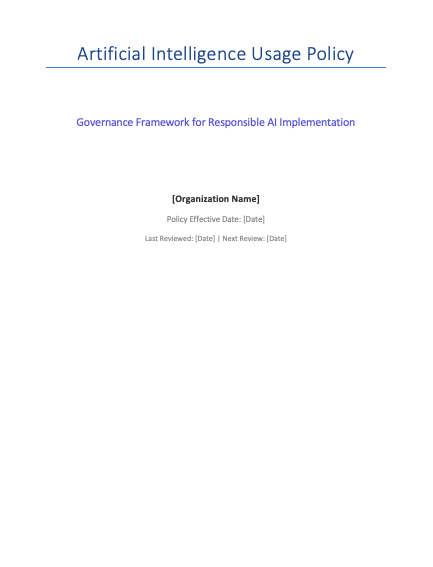
Done! The Word document provides your comprehensive policy framework with executive summary, detailed policy sections covering data privacy and ethical use, staff guidelines with clear dos and don'ts, governance structure defining roles and responsibilities, implementation timeline, and appendices with templates and forms. The document uses sophisticated formatting with a professional color palette, clear hierarchy, and consulting-grade polish suitable for board presentation.
The Excel workbook becomes your implementation and tracking tool with tabs for: use case request intake and approval workflow, risk assessment matrix with scoring rubrics, training completion tracking with staff roster, vendor evaluation checklist for AI tool procurement, compliance monitoring with quarterly review schedule, and policy exception log. The workbook includes data validation dropdowns, conditional formatting highlighting risks, working formulas for scoring, frozen headers for navigation, and an executive dashboard summarizing governance status.
Both deliverables are immediately usable and require minimal editing.
The policy includes the following sections: Governance Framework, Data Privacy & Protection, Appropriate Use Cases, Staff Guidelines, Ethical Standards, and Implementation Plans.
The implementation workbook includes: use case requests, risk assessment, training tracker, vendor evaluation, compliance monitoring, and exception logs.
Provide staff with a high level understanding of the AI policy and pull out information that is most important to them.
Create training slides and handouts covering: policy highlights, practical examples relevant to our work, common scenarios staff will encounter, and clear decision trees for when to use AI versus when to escalate to human judgment.
Create a PowerPoint presentation to introduce this policy to the board.
Create a PowerPoint presentation I can use to introduce this policy to our board. Focus on: why AI governance matters for nonprofits serving vulnerable populations, key policy provisions and rationale, implementation timeline, how this protects our mission, and how we'll measure compliance.
Draft messaging for donors explaining your approach to AI.
Help me draft messaging for donors explaining our approach to AI - emphasizing data protection, ethical use, and mission alignment. Include language for annual reports, website FAQs, and responses to direct questions.
This policy template addresses common considerations like HIPAA for health information, but legal compliance varies significantly by location. Ask Claude to research regulations specific to your state or country: "What AI-related regulations apply to nonprofits in [your state/region]?" Then have legal counsel review the policy to ensure it meets your jurisdiction's requirements before board adoption.
This creates a comprehensive foundation, but you know your organization's unique risks. After reviewing, ask Claude to strengthen specific sections: "Add more detail about volunteer use of AI tools" or "Expand the section on handling images of minors" or "Include specific language about our advocacy work and AI-generated content."
Different staff need different levels of detail. Ask Claude to create condensed versions for specific roles: "Create a one-page summary for program staff focused on beneficiary data protection" or "Draft guidelines for development team covering donor communications and prospect research." This makes the policy more actionable.
The AI landscape changes rapidly. The policy includes an annual review schedule, but also add triggers for interim updates: when adopting new AI tools, after policy violations, when regulations change, or based on sector guidance. Ask Claude to add a "Policy Amendment Process" section if you want to formalize this.
When presenting to staff, lead with what they can do with AI tools (donor communications, grant research, administrative tasks) before covering restrictions. This frames the policy as enabling responsible use rather than just limiting behavior. Claude can help you reorder sections if the default structure feels too restrictive.